Preface
The “Property Consolidator” automatically iterates through all instances of an asset type. The goal is to create a single, unified “target property” that can replace multiple existing “source” properties. To achieve this, it checks if the defined source properties exist and writes the first found value to the specified target property. If the target property does not already exist, it is created. Otherwise, it is updated. The “Property Consolidator” is intended to be used in combination with the Property Deleter, which is employed to remove either redundant or inconsistent properties.Configuration
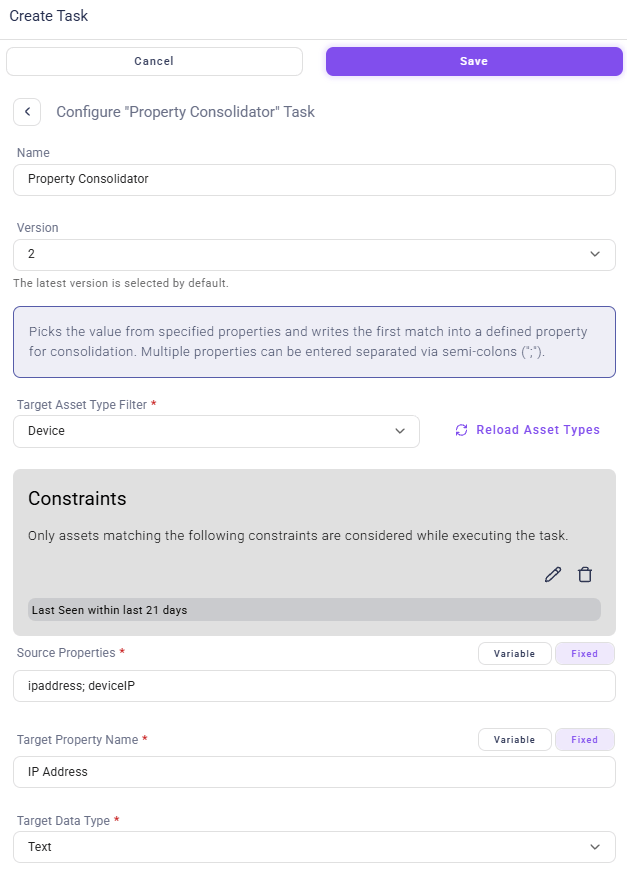
Select Target Asset Type
Use the dropdown menu to select the asset type for which the later defined properties should be consolidated. By default, the Consolidator will check all asset instances.Define Constraints (optional)
You can define constraints to limit consolidation to specific asset instances. For instance, you can restrict consolidation to assets that originated from a particular data source or that have not been seen in a certain amount of time.Define Source Properties
Enter the names of all the properties to be processed, separating them with semicolons. For example, if multiple properties reflect an asset’s IP address, name them all here to create a unified property. You can either type fixed values (text strings) for the names of the source properties or choose an existing value from your set of predefined Variables.Define Target Property
Enter the desired name for the “target property,” which is the property that all processed asset instances will ultimately have. If the target property already exists with the same name and type, it will simply be updated. Otherwise, the Consolidator will create a new property for the asset instance. You can type fixed values (text strings) for the names of the source properties, or you can choose an existing value from your set of predefined Variables.